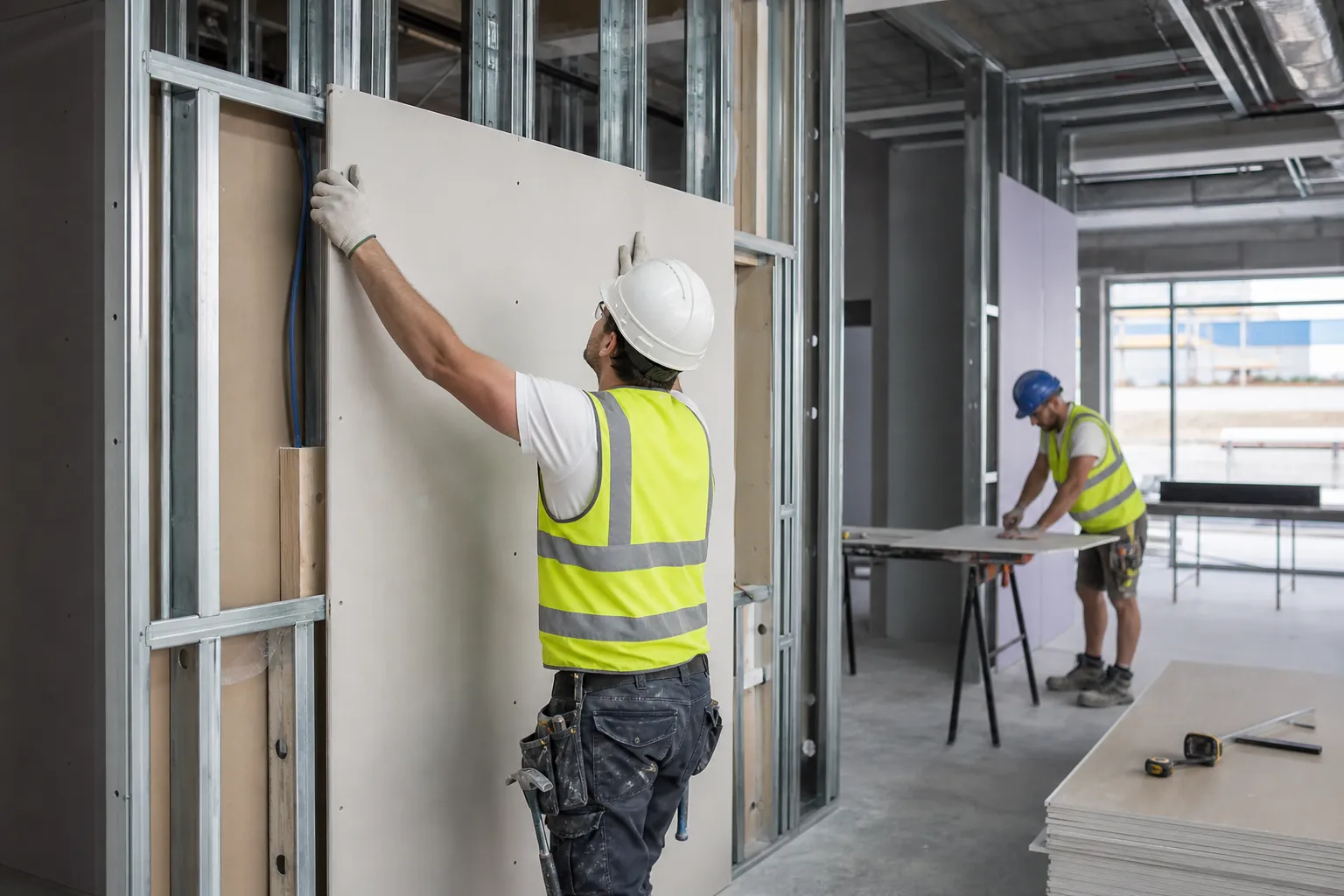
Dry lining has become the default approach for lining blockwork and concrete in commercial buildings — and for good reason. Compared with traditional wet plaster, boarded systems give predictable levels, faster drying times, and simpler integration of insulation and services.
Speed and programme certainty
On refurbishment programmes where every week of downtime costs money, dry lining lets follow-on decorators mobilise sooner. Dot-and-dab or direct fix methods are selected based on substrate condition and tolerance requirements.
Performance upgrades
Thermal boards, acoustic laminates, and moisture-resistant plasterboard can be specified zone by zone — something that is harder to achieve consistently with wet trades alone.
Finish quality
With skilled tape-and-joint work to Level 4 or Level 5, dry lined walls accept paint, wallpaper, or feature cladding without telegraphing board joints. That is why main contractors and shopfitters across the North East specify dry lining on the majority of fit-out packages.
At Erimus Interiors we combine dry lining with our ceiling and partition services so interfaces at wall heads and abutments are handled by one accountable team.